If you arrived here via focuswesthealth.com
You are in the correct place. The FocusWest Health Inc. website is under construction.
The technology
The Robotic WideField Breast Ultrasound Tomography Platform (patented)
Every breast imaging radiologist and facility will want this disruptive technology. There is no learning curve for the radiologist, who will no longer need to repeat a technologist's scans.
RoWBus™ eliminates many of the current breast ultrasound problems, especially the severe shortage of technologists and their frequent work-related injuries. It precisely images the most breast tissue at every examination, allows correct comparison to images from other modalities, and minimizes false positives. In partnership with AI DL Radiomics, it can safely find breast changes before the human eye. Without compression, manipulation, or distortion, it is safe, repeatable, and comfortable for women of all ages, for diagnosis and screening.
- Addresses a severe shortage of trained ultrasound technologists
- Precisely images the most breast tissue at every examination
- Allows correct comparison to images from other modalities
- Minimizes false positives
- Paired with AI DL Radiomics to safely find changes before the human eye
- No compression, manipulation, or distortion — safe and comfortable for women of all ages
The team
A patient-oriented startup
FocusWest Health has assembled a team of international experts, each of whom is a star in their respective areas of breast imaging, Radiomics, medical ultrasound, and clinical care — another perspective that makes FocusWest Health unique.
Dr. Philip Kivitz, a pioneer in the breast imaging and healthcare space and a board-certified radiologist, became the first “primary care physician for the breast” when he envisioned, developed, established, and led the San Francisco Breast Evaluation Center (SFBEC). The current FocusWest Health patented technological innovation is based on a prior, FDA-approved breast ultrasound device that he and dozens of other breast imaging radiologists at the time used in their clinical practices.
Dr. Kivitz's decades of experience as Senior Reviewer and Inspector for MQSA, inspecting mammography facilities across the US, talking with dozens of radiologists, and training hundreds of technologists, inform his knowledge of what breast imaging radiologists want and need.
October 1981
One woman's story
A 38-year-old woman arrives at the San Francisco Breast Evaluation Center describing a gradually enlarging right breast mass. The innovative whole breast water-bath ultrasound device we were using at that time clearly reveals a benign cyst (fluid-filled) — a very common breast mass that is benign. In our practice we routinely image both breasts in search of any occult abnormalities: screening. This takes only a few more minutes.
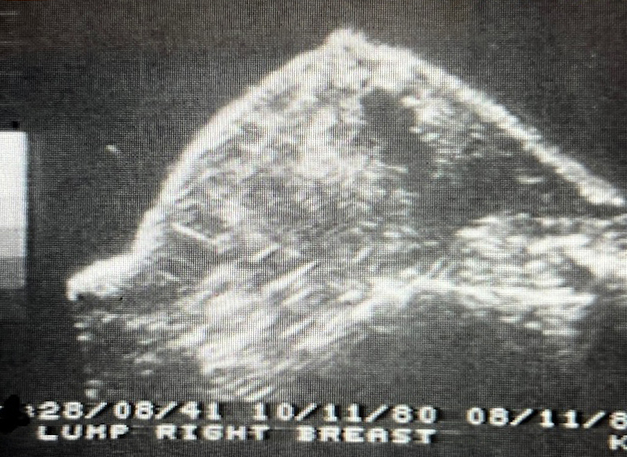
The original 1981 ultrasound image, labeled “Lump right breast.”
An abnormal solid mass is found in the same breast, but another area — the unsuspected mass is a pathology-proven invasive ductal carcinoma. It would have remained undetected until it grew large enough to feel, and possibly spread to her lymph nodes.
The mass was obscured on mammography by dense tissue. It is known that mammogram images with dense breast tissue can miss 20–40% of cancers. Dr. Kivitz's early pioneering medical ultrasound experience during his residency, and research by others, showed that supplemental ultrasound imaging could reveal early changes in mammographically dense tissue before it was generally appreciated. When appropriate, it became an integral part of the SFBEC patient experience, along with the most innovative mammography, ultrasound-guided fine needle biopsies, stereotactic x-ray fine needle biopsies, and others.
Today
Dr. Kivitz and the FocusWest Health team bring their extensive experience in breast imaging and breast healthcare to women in need of Precision Medicine — wherever there is a road.
Contact: pghs456@gmail.com